Lloyd Rivera – Top Latinos
Albuquerque, NM /LWW/ Mr. Lloyd Rivera, Artist, Community Organizer & Historian, has been recognized by the Top Latinos in the 2026 edition.
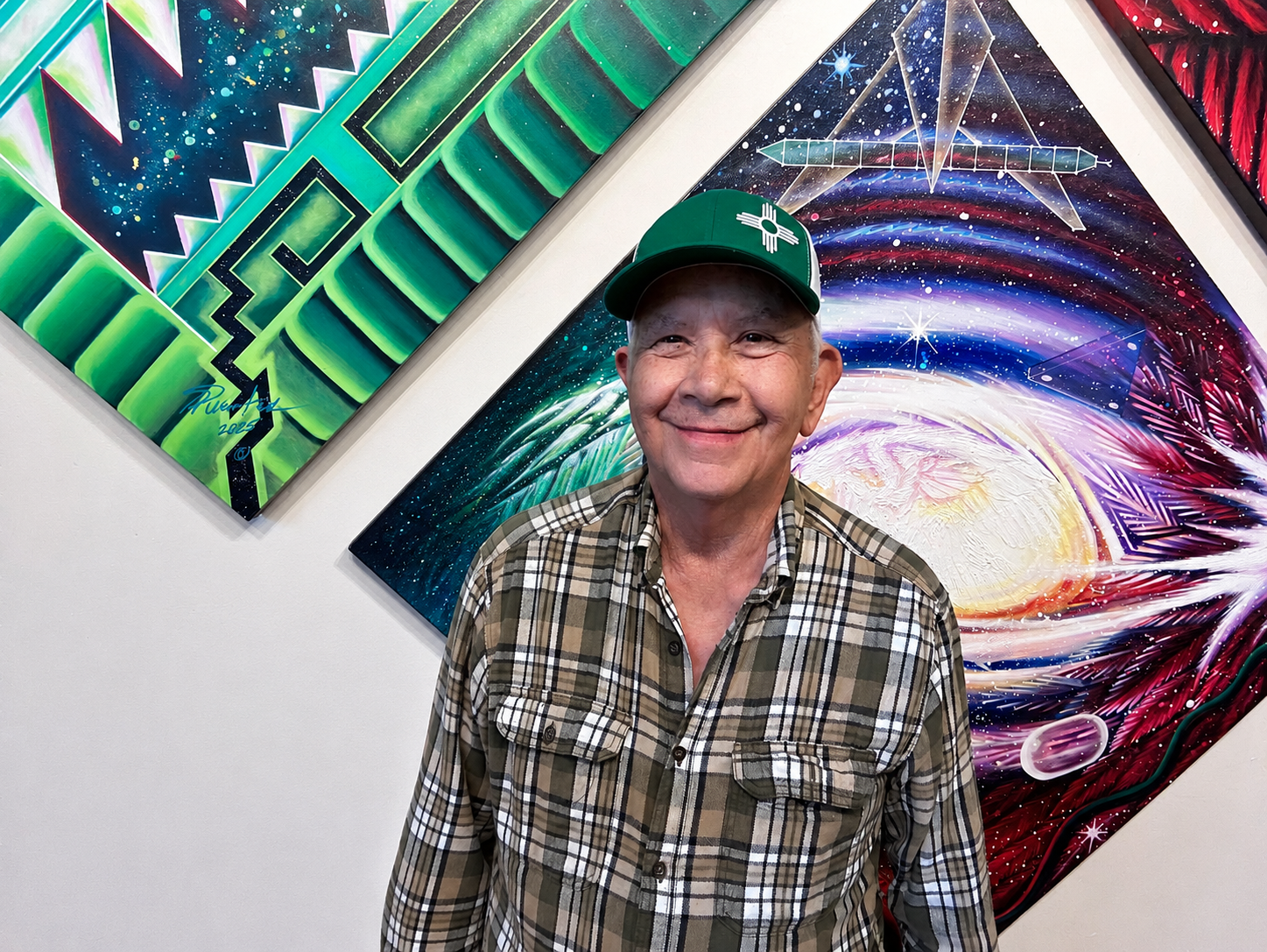
There are artists who find their path early, guided by teachers and studios and parents who hang drawings on the refrigerator. And then there are artists like Lloyd Rivera, whose calling arrived quietly, through the glossy pages of a magazine, in a valley far from any gallery or art school. His story is not just about making beautiful things. It is about reclaiming a cultural identity that the art world spent more than a century trying to overlook.
Lloyd Rivera grew up in the Mora Valley, one of the most rural and economically challenged corners of New Mexico, in a county that ranks among the second poorest in the entire United States, just behind Appalachia. There were no artists in his family. No studios, no exhibitions, no mentors pointing him toward a canvas. What he had was curiosity, and curiosity turned out to be enough.
It was reading magazines like Time that first opened Lloyd’s eyes to the world of visual art. Flipping through those pages, he encountered the work of Diego Rivera, Marc Chagall, Pablo Picasso, and other masters whose images jumped off the page and planted something inside him that would not go away. This was not a passive appreciation. It was an awakening.
That self-taught hunger eventually led him to New Mexico Highlands University, where he turned that curiosity into academic commitment. He earned both his BA and MA by 1975, actively pursuing coursework in drawing, painting, and art history. For a young man from a valley with no artistic tradition in his household, this was a remarkable leap. Education became the bridge between what he had seen in those magazines and what he would eventually create with his own hands.
Lloyd Rivera began producing his own sacred folk artifacts around 1987, and his approach was unlike anything being made in the region at the time. Working with acrylics on aged wood, he developed a practice that combined the visual language of traditional New Mexican religious art with his own evolving artistic sensibility.
Out of this practice came his most original concept: the recuardos. These are four saint images painted on blocks of wood, each one a small, reverent object that honors the devotional traditions of his Hispano and Indo-Chicano heritage. The word itself carries meaning, echoing the Spanish concept of memory and keepsake. A recuardo is not just a painting. It is a remembrance.
The choice of aged wood matters too. There is something intentional about painting sacred figures on surfaces that have already lived a life, that carry the texture of time. It connects the spiritual to the physical in a way that new, pristine materials simply cannot replicate. Lloyd’s work does not just depict saints. It situates them inside history.
Lloyd Rivera has never been content to work in isolation. Since moving to the Taos area in 1981, where he has lived and created for more than four decades, he has been deeply involved in the broader artistic community, particularly in efforts to lift up those who have been historically overlooked.
As a founding member of the Taos Hispanic Arts Council, he helped build an institutional voice for Hispanic artists in Northern New Mexico. This work was personal. The art world in Taos has a complicated history. When the white art colony formed in 1912, it brought national attention to the region but largely excluded the Indian, Mexican, Chicano, and Latino artists who had been part of that landscape for generations. The cultural richness of these communities was sometimes used as backdrop while the people themselves were pushed to the margins.
Lloyd saw this clearly, and he refused to accept it as the final word.
In 2023, Lloyd took his advocacy to a new level by founding CHACO Volunteers, which has since grown into a formal entity: the Chicano-Hispano-Azteca-Latino-Culture-Organization. This is not a small gesture. Building an organization from scratch, with a name that deliberately includes every community that was left out of the original Taos art narrative, is a statement about belonging and visibility.
CHACO exists to correct a long-standing omission. For over a century, the cultural history of Northern New Mexico’s Indo-Chicano communities has been absent from school curricula and mainstream art institutions alike. Many people do not know, for example, that much of the Spanish spoken in Northern New Mexico carries words with Aztec Nahuatl origins, a linguistic thread connecting contemporary communities to ancient Mesoamerican civilizations. This is not trivia. It is identity.
Lloyd speaks Spanish, English, and the Spanglish dialect native to Northern New Mexico, shifting fluidly between them the way his community always has. This bilingual and bicultural fluency is not a liability or a quirk. It is a cultural inheritance, and it informs every aspect of his artistic and advocacy work.
Beyond painting and organizing, Lloyd Rivera has conducted voluntary ethnographic research tracing the Indo-Chicano ancestry that connects the Taos Art Colony to its deep historical roots, all the way down to CHALCO in Mexico. This kind of research requires patience, dedication, and a willingness to sit with uncomfortable truths about how history gets recorded and who gets to tell it.
His work in this area is a form of art in itself. By documenting what has been lost, distorted, or simply ignored, Lloyd is adding to the cultural record in a way that future generations of Northern New Mexico artists and scholars will be able to draw from. He is not waiting for someone else to write this history. He is doing it himself.
When Lloyd Rivera talks about his vision, the phrase he returns to is “New Folk Art for the New Millennium.” It is a declaration as much as a description. He is not trying to preserve something frozen in the past. He is taking the roots of his heritage and growing something new from them, something that speaks to the present moment without abandoning where it came from.
This vision connects directly to his excitement about Open Studio, the kind of event that allows artists to step out from behind gallery walls and meet people where they are. For Lloyd, Open Studio represents more than a sales opportunity or a networking moment. He sees it as a door opening onto the larger world art community, a chance to share his work, his culture, and his ideas with people who might never have encountered the sacred folk art traditions of Northern New Mexico.
After years of building infrastructure for others, conducting research no one asked him to do, and quietly creating work in a valley that the mainstream art world rarely visits, Open Studio feels like a long-awaited invitation. And Lloyd Rivera is ready to walk through that door.
Lloyd Rivera’s story is a reminder of what becomes possible when someone refuses to accept the limits placed on them by geography, economics, or institutional neglect. He came from the second poorest county in the United States, with no artists in his family and no roadmap, and he built a life of extraordinary creative and cultural purpose.
He studied the masters through magazine pages and then earned the credentials to stand alongside them academically. He developed an original artistic language rooted in sacred tradition and aged wood. He helped found organizations designed to give other artists the recognition they deserve. He conducted research that connects living communities to their ancient ancestors. And through it all, he has kept creating, block by block, saint by saint, recuardo by recuardo.
His vision of New Folk Art for the New Millennium is not a nostalgic project. It is a living, growing body of work from a man who understands that culture does not survive by accident. It survives because people like Lloyd Rivera show up, day after day, and make sure it does.

Top Latinos is a prestigious New York publication dedicated to honoring the achievements of the Latino community. They meticulously identify and honor outstanding Latino professionals nationwide who have reached impressive levels of success in their respective fields. By showcasing their accomplishments, they aim to foster growth and appreciation of the Latino industry and culture. Since their establishment in 2010, Top Latinos has been wholeheartedly committed to fulfilling their mission of bringing awareness to the exceptional contributions made by the Latino professional and executive community.
MESSAGE